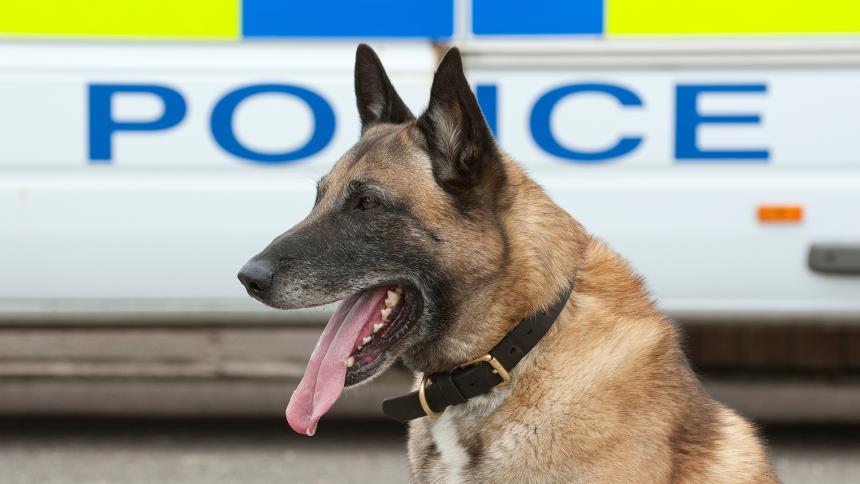
Police dogs: The history and future of K9 law enforcement
K9 PD with Jim BelushiDogs have often played a part in uncovering crimes. Gruesome examples include the Babes in the Wood murders in Epping Forest, where Leonard Cook’s dog led him to stumble across two children’s carefully concealed corpses.
So, it’s no wonder that police organisations around the world have long had their own dog (K9) units. These heroic hounds have done everything from finding drug stashes to tracing missing people and even chasing suspects on the run.
The long arm of the paw has now inspired a whole new series, Crime+Investigation’s K9 PD with Jim Belushi, starting Friday, 26th June. What else makes a dog a police officer's best friend? To answer that question, Crime+Investigation takes a look at how these heroic hounds have been a cornerstone of law enforcement for centuries.
The early history of police dogs
Historical records of police dogs go as far back as the Middle Ages. When it comes to investigative work, individual dog breeds differ in their strengths and drawbacks. Bloodhounds are among the most tried and tested, having been used in 14th-century Scotland, where they were known as ‘Slough dogs’.
After Jack the Ripper began his killing spree in the 1880s, London police commissioner Sir Charles Warren sought to use bloodhounds to track him down. Unfortunately, Warren’s attempts to train the dogs went awry, with one even biting him.
It would be some time before humans learned how to make the best use of police dogs. However, after they were introduced in Ghent, Belgium in 1889, law enforcement bodies elsewhere, like the UK’s North Eastern Railway Police, soon followed suit.
What are police dogs used for?
Police dogs fall into two broad categories: ‘general purpose’ and ‘specialist’. The former are used to deter suspects from fleeing – and, if they flee anyway, chase and apprehend them. These dogs, usually German Shepherds, Dutch Shepherds or Belgian Malinois, can also protect human officers and find evidence.
Other jobs are so demanding that they have to be left to dogs specially trained for them. Here, it’s important to acknowledge dogs’ phenomenally strong sense of smell – thousands of times more sophisticated than humans’. Particular dog breeds especially excel in this regard.

Take the example of bloodhounds, which can follow a scent trail extending as far as 130 miles. This enables them to locate missing people especially effectively. These days, you even get ‘digital detection dogs’ – so-called as they can pick up on the metallic scents of smartphones and laptops potentially hiding evidence.
Police dog regulations in the UK
In the UK, police dogs legally belong to the police responsible for purchasing, training and deploying them. In other words, they are not seen as the personal property of the individual officers tasked with handling them on a day-to-day basis.
Police dogs’ handlers around the world are required to heed animal welfare laws applicable to their respective jurisdictions. This legislation can be refined, revamped and adjusted over time. In 2019, the UK introduced the Animal Welfare (Service Animals) Act, preventing those who injure police dogs from avoiding legal retribution on ‘self-defence’ grounds.
The National Police Chiefs’ Council (NPCC) Police Dog Standard and the College of Policing’s Authorised Professional Practice (APP) were launched in 2024. NPCC Assistant Commissioner Pippa Mills explained: ‘The new NPCC Police Dog Standard sits alongside the APP, streamlining the previous guidance and mandating minimum standards.’

The future for dogs in law enforcement
Over the centuries, police dogs have more than proved their worth – but is it now time for them to permanently retire to their kennels? In 2024, PETA cited alarming instances of canine cops ‘dying from overheating or in other horrific ways’.
The animal welfare charity has consequently called on policing organisations to ‘phase out the use of dogs altogether’. We might already have seen their potential replacements. The use of robotic dogs has been trialled for law enforcement purposes on both sides of the pond.
In 2023, New York’s then-mayor Eric Adams unveiled one such robot, ‘Digidog’, designed to assist in hostage standoffs and other dangerous situations. Nonetheless, Albert Fox Cahn, executive director of the Surveillance Technology Oversight Project, dismissed Digidog as a ‘knockoff RoboCop’.
Even Nottinghamshire Police’s AI-powered attempt ‘Watson’, put through its paces in late 2025, was not built to chase suspects or sniff out contraband. So, flesh-and-blood dogs look set to remain valued members of police forces across the world for the foreseeable future.
Keen to learn about other clever methods of investigating crimes? Start by signing up for the Crime+Investigation newsletter. We regularly send fresh, engrossing content to subscribers’ email inboxes.