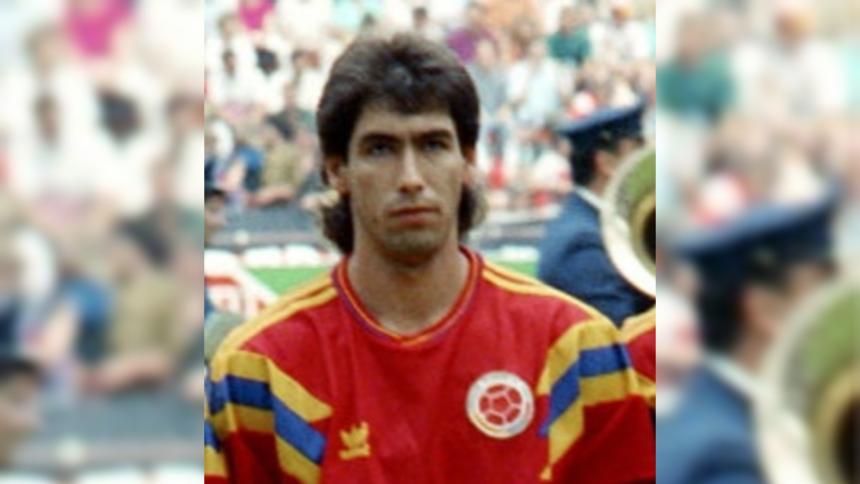
Andrés Escobar: Murdered after scoring an own goal
When people talk about dark times in football history, one name always comes up: Andrés Escobar.
Known as 'The Gentleman' for his calm demeanour and sportsmanship, Escobar was one of Colombia’s most respected footballers. But in the summer of 1994, a single moment on a football pitch would become forever linked to one of sport’s most shocking murders.
Crime+Investigation examines the assassination of Andrés Escobar, the circumstances that led to it, and the question that has never been fully resolved: was football really the reason he died?
The moment everything changed
Colombia's World Cup campaign got off to a disappointing start with a defeat to Romania. That left their second group game against the United States as a must-win match.
In the 35th minute, American midfielder John Harkes delivered a low cross into the penalty area. Escobar stretched to intercept it, hoping to clear the danger. Instead, the ball diverted off his leg and into Colombia's own net. Escobar had scored an own goal, which might’ve been a normal disappointment in normal games; this time, the fateful error led to the footballer’s sudden death.
It was an accident. The kind of mistake that can happen to any defender. But the own goal gave the United States the lead in a game they eventually won 2-1. The result pushed Colombia to the brink of elimination and shattered the expectations surrounding the team.
Although Colombia won their final group match against Switzerland, it wasn't enough. Their World Cup was over far sooner than anyone had anticipated.
Return to Colombia
Despite the disappointment, Escobar handled the criticism with remarkable dignity.
In a newspaper column written shortly before his death, he urged Colombians to maintain perspective and remember that life continues beyond football. Friends described him as 'disappointed but optimistic about the future.'
After returning to Medellín, Escobar resumed normal life. However, on the night of 1st July 1994, he went out with friends to a restaurant and nightclub on the outskirts of the city.
What should have been an ordinary evening quickly turned into an evening of terror.
The night Andrés Escobar was killed
During the early hours of 2nd July, Escobar became involved in an argument in a nightclub car park.
Witnesses later reported that a group of men began taunting him about his own goal against the United States. Among those present were brothers Santiago and Pedro Gallón, wealthy figures who had long-standing links to organised crime and were alleged to have lost significant sums of money betting on Colombia's World Cup campaign.
Accounts differ on precisely how the confrontation escalated, but the argument became heated. Then, Humberto Muñoz Castro, a bodyguard and driver employed by the Gallón brothers, pulled out a handgun and opened fire.
Escobar was shot multiple times.
Several witnesses later claimed that the gunman shouted 'Goal!' after each shot, a chilling reference to the own goal that had dominated headlines around the world. Escobar was rushed to the hospital but died approximately 45 minutes later. He was just 27 years old.
Was football really the motive?
The murder became international news. Why wouldn’t it? A famous footballer was killed after scoring an own goal.
There is certainly evidence that the own goal played a significant role in the confrontation. Investigators found that Escobar had been mocked about the incident shortly before he was killed. Several individuals connected to the case reportedly had financial interests tied to Colombia's World Cup performance.
However, some investigators and former members of Colombian football have argued that the story is more complicated. Years later, former Colombia manager Francisco Maturana suggested that Escobar's death reflected the wider violence that plagued Colombia at the time rather than being solely about football.

The investigation
Unlike many high-profile murders, police quickly identified a suspect. Humberto Muñoz Castro was arrested shortly after the shooting and confessed the following day. Investigators established his connections to the Gallón brothers, who themselves came under scrutiny during the inquiry.
Muñoz was convicted of murder and sentenced to 43 years in prison in 1995. However, changes to sentencing laws and reductions for good behaviour dramatically reduced the time he served. He was released in 2005 after 11 years behind bars.
For more on the criminal cases that have intersected with the world of sport, sign up to the Crime+Investigation newsletter. Every week, you'll receive the latest articles, episodes and more from C+I delivered straight to your inbox.