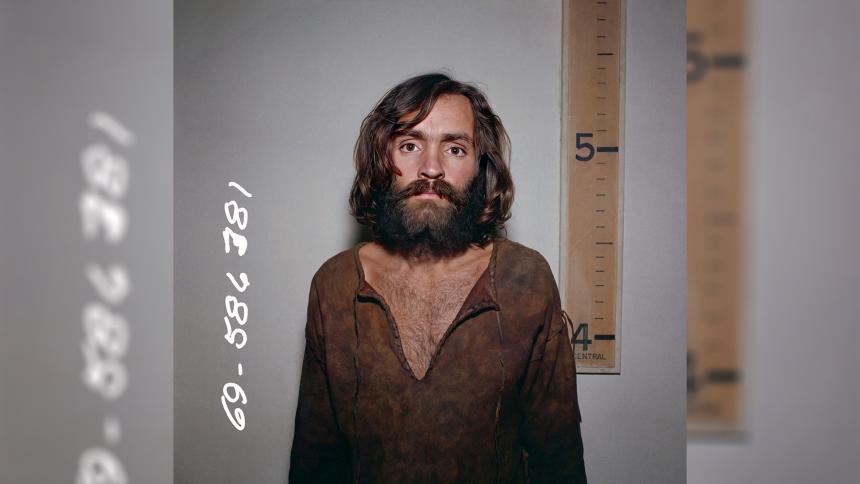
Charles Manson: What is the CHAOS Theory?
Nearly six decades after the infamous 1969 Tate-LaBianca murders, most people still know the gruesome outline. Manson instructed his followers to slash through the homes of Sharon Tate and others, leaving a trail of violence that shocked the world.
But there are still some unanswered questions and alternative lines of inquiry worth examining. Not to rewrite history, but to understand how and why these horrific events occurred. Join Crime+Investigation as we dig into Charles Manson and the crimes committed by his followers.
A twisted interpretation
The story that has dominated public understanding for decades was laid out most clearly in Helter Skelter, the 1974 book by prosecutor Vincent Bugliosi. Bugliosi argued that Manson indoctrinated his followers with the idea of an impending race war, a belief he claimed Manson took from a twisted interpretation of The Beatles’ White Album.
But was this true?
That narrative shaped the lens through which Manson was viewed for generations. But it also left some serious questions unanswered, especially around how Manson was able to exert such intense psychological control over a group of young adults in such a short period of time.

Mind control or master manipulation?
Over time, some researchers began to ask whether Bugliosi’s explanation, while legally sufficient, told the whole story. Among the most controversial alternative theories is the suggestion that Manson may have been exposed to CIA-funded drug experimentation during the 1960s, potentially influencing his psychological development and methods of control.
This is one of the many theories surrounding Manson, but there is no conclusive evidence proving that Manson was part of any CIA programme.
The notion is that the Manson family might have been brainwashed by or connected to the CIA’s Project MKUltra, a covert program that experimented with LSD and other psychoactive substances, often administered to unwitting subjects. This asked the question:
Was Manson working within his own mind, or was he being controlled by a larger entity?
Raising the theories
The modern communication of the CIA-influence theory largely stems from journalist Tom O'Neill, whose 2019 book CHAOS: Charles Manson, the CIA, and the Secret History of the Sixties was the product of nearly two decades of research.
O’Neill initially set out to write a magazine article marking the anniversary of the murders. Instead, he found himself questioning inconsistencies in court transcripts, investigative records and parole documentation.
His conclusions were cautious but challenging. He did not claim the CIA orchestrated the murders. He did not claim Manson was a programmed assassin. What he argued was even more unsettling. He suggested that Manson’s movements in San Francisco’s Haight-Ashbury district overlapped with research environments tied to government behavioural studies. Mind-blowing, right?
According to O’Neill’s theory, some of those studies were directly or indirectly connected to MKUltra subprojects. LSD experimentation was widespread, and certain researchers in that world had received CIA funding.
The Haight-Ashbury intersection
After being released from prison in 1967, Manson gravitated toward the Haight-Ashbury counterculture, where psychedelic drug use was common. LSD was distributed both recreationally and in research settings.
O’Neill identified that certain clinics in the area had links to psychiatrists and researchers who had participated in CIA-funded behavioural studies. However, there is no official documentation stating that Manson himself was a registered subject in an MKUltra program.
Sceptics counter that the 1960s counterculture was awash with LSD regardless of CIA influence, and that many charismatic leaders used manipulation without any intelligence-agency involvement.
Legal leniency?
Another thread O’Neill examined was Manson’s apparent legal leniency before the murders. Despite repeated parole violations, he avoided lengthy incarceration.
Some researchers have questioned whether this suggests a deeper institutional relationship.
However, critics point out that bureaucratic inconsistency and overloaded probation systems were common at the time. Administrative failure does not necessarily equal covert protection. As with the other theories mentioned, this one also remains circumstantial.
While there are some good questions being asked surrounding Manson, legal historians and former prosecutors maintain that the evidence presented at trial clearly shows Manson’s manipulative personality and how he exploited vulnerable young people.
Love true crime? Stay in the know with the Crime+Investigation Newsletter! Get exclusive access to new articles, episodes, clips, competitions, and more – delivered weekly and completely free. Don't miss out – sign up today!