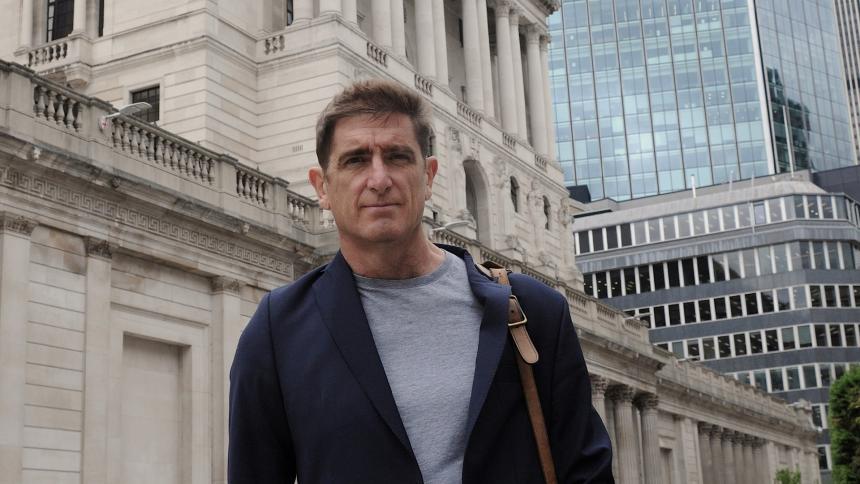
Marcel Theroux on the infamous Louvre heist
Heist: Robbing the Bank of EnglandOn the day that thieves stole three works of art from the Renoir Museum in the south of France, broadcaster Marcel Theroux pens a guest article covering the infamous Louvre heist of October 2025. He investigates what happened, why the crime captured the attention of the world, and the parallels with the London City bonds robbery from 1990.
Marcel fronted Heist: Robbing the Bank of England for Crime+Investigation, a documentary that revealed the true story of history's biggest robbery you've never heard.
When the Louvre robbery happened in October, I followed the accounts of the crime and its aftermath with a feeling of déjà vu. I had spent much of the past year working on a series for Crime+Investigation about the City bonds robbery, a record-breaking heist that took place in 1990. While there are obviously big differences between the two cases, there are some illuminating similarities.
One of the things that film’s director Sam Miller and I were keen to explore was the difference between the myth and the reality of such crimes.
If you watch Heist: Robbing the Bank of England, you’ll see that Sam directed a bravura opening that dramatises the classic elements of a heist. In it, criminal masterminds come up with an audacious plan to steal something of incredible value; they execute that plan and make a clean getaway.

By a strange coincidence, just over two weeks before the first episode was due to air, news broke of the brazen robbery at the Louvre in Paris. My first thought was to make sure that Sam had an alibi. The heist contained all the elements that he had imagined. If he’d been working with a bigger budget, it was exactly the sort of crime he’d have wanted to film.
As with the City bonds robbery, the break-in at the Louvre seems to have begun with someone noticing a vulnerability around items of great value. In 1990, it was the fact that middle-aged men were wandering around the City of London carrying financial instruments worth millions of pounds. In 2025, someone appears to have realised that one of the world’s great museums had some striking weak points in its security. They decided to exploit this.
At 9:30am on Sunday, 19th October, a team of criminals parked a hired ladder-lift truck just below one of the Louvre’s balconies. The audacity of this is hard to exaggerate: this was happening in central Paris, in broad daylight, when the museum was open to the public.
Two members of the team went up the ladder in a hydraulic basket, broke through the window and entered the opulent Apollo gallery. It’s a long, narrow space with ornate gold mouldings, elaborately painted ceilings and a row of secure glass cases down the middle. These house some of France’s most valuable and historic crown jewels.

Working very swiftly, the robbers used power tools to open two of the cases, helped themselves to the contents and went back out of the window. A clip on social media shows the two men descending in the hydraulic bucket with their haul.
During the four minutes they spent in the gallery, they managed to scoop up eight items of irreplaceable historic value. These were 19th century pieces that had belonged to members of the French royal family: a sapphire tiara, a sapphire necklace, a single sapphire earring; an emerald necklace, two emerald earrings, a pearl tiara and a diamond encrusted bow-shaped brooch. The thieves also picked up a large diamond and emerald encrusted crown, but one of them dropped it on their way out.
At the foot of the ladder, the robbers got on the back of two high-powered motor scooters driven by accomplices and made their getaway. The entire operation took less than eight minutes to complete.
The historic importance of the jewels makes their value hard to estimate, but a figure of 76 million pounds has been placed on the haul.
It was a breathtakingly bold crime. It gives the impression of ruthless criminal brilliance. And the initial statements by French police suggested that the men were experienced robbers, acting on behalf of some shadowy mastermind.

At this point, it’s worth pausing to reflect on the similarities between the Louvre heist and the City bonds robbery. There are some key differences of course: the looted jewellery is clearly more photogenic than the paper securities that Patrick Thomas stole back in 1990. And there is a special Gallic panache about the ladder, the beautiful gilded gallery and the idea of high-powered scooters weaving through Parisian traffic. But the key question that faced the criminals in both cases was the same: how do they turn their stolen property into profit?
While making Heist: Robbing the Bank of England, I had interviewed an armed robber called Marvin Herbert who said he’d been aware that the job of stealing the bearer bonds was being offered around the criminal underworld. He hadn’t been interested. He only did robberies involving cash because he was put off by the difficulty of fencing stolen items. The bearer bonds with a face value of millions of pounds were worth nothing in the hands of Patrick Thomas, or Marvin Herbert, or you and me. You need someone with the connections and the know-how to launder them.
And though the jewels stolen from the Louvre, being made of gold and precious stones, have an intrinsic value, they are also unique and easily identifiable. This makes it hard to realise anything close to their actual worth. No legitimate person or institution will touch them.
That suggests two possibilities. Perhaps, somewhere in the world, there is an oligarch with a private museum of stolen art who has a hankering for these treasures and commissioned someone to get them. It’s an intriguing idea, but it doesn’t seem very plausible.

More likely - and more sad - is the second possibility. In this scenario, the value of the jewellery will be realised by breaking the items up, chiselling out the jewels, melting down the gold and selling the anonymous fragments for a fraction of their actual worth.
The venality and desperation of this reminds me strongly of the City bonds robbery.
As we researched that robbery in more detail, we learned that some of the key figures involved were more Mr Bean than Mr Big.
This isn’t really surprising. There is no LinkedIn for criminals, no reliable way of checking the intelligence or trustworthiness of potential collaborators. There is no headhunter administering personality tests to ensure the team has the right balance of skills to carry out the job. Criminals are not notorious for conscientiousness, teamwork and thinking things through.
After the bonds had been stolen, the criminals struggled to realise even a tiny part of their value. In the process of fencing them, conspirators were arrested, informed on one another, and some lost their lives.
The apparent sophistication of the crime vanished in a puff of betrayals, recrimination and violence. I am curious to see how closely history repeats itself with the Paris heist.
Details of the Louvre robbery are still emerging, but it was also less perfectly executed than first appeared. The suspects left items at the scene, a glove, a motorcycle helmet, and the truck they had used to reach the balcony. This has led to French police rounding up all four people who appear to have been involved.
As for the jewellery, there is still no sign.