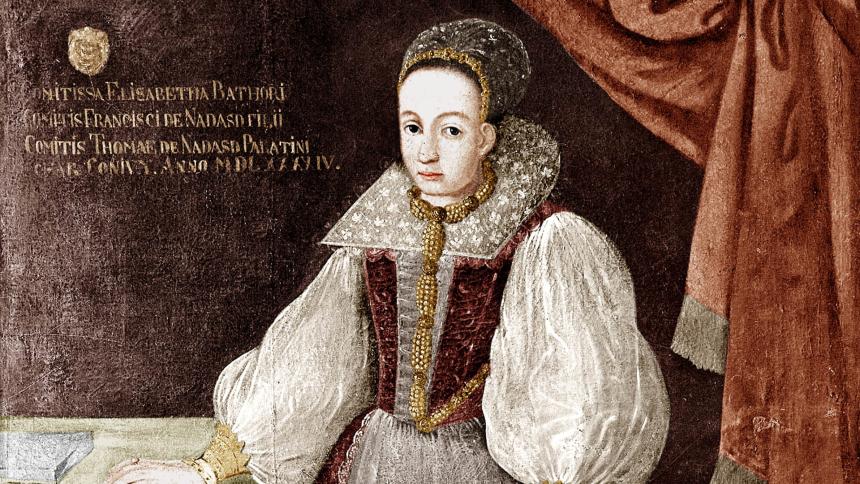
Elizabeth Báthory: The legend of the 'Blood Countess'
You might not have heard of Elizabeth Báthory, but you’ll have undoubtedly stumbled across her influence in films, television shows and even video games.
The so-called 'Blood Countess' inspired the Evil Queen in Snow White, and her legend influenced Lady Gaga’s Countess in American Horror Story: Hotel.
Wherever she went, whispers of torture, witchcraft and orgies followed. But was she really one of the most prolific serial killers of all time or simply the victim of a larger political conspiracy? Crime+Investigation examines the life of Elizabeth Báthory – the allegations that made her infamous, and the historians who argue the truth is far more complicated.
Who was Elizabeth Báthory?
Elizabeth Báthory was born in 1560 in Nyírbátor, Royal Hungary. Her family was enormously wealthy, owning huge estates and wielding influence among many of the region’s noble families.
Unlike other girls of the period, Elizabeth was well-educated. She was an enthusiastic reader and spoke several languages, including Hungarian, German, Latin and Greek.
But wealth and status couldn't protect her from the brutality of the time. As a child, she reportedly suffered from frequent seizures, with treatments said to have included rubbing the blood of a non-sufferer onto her lips. She also witnessed public executions and other acts of extreme violence while growing up at Ecsed Castle.
When she was around 11 years old, Elizabeth was betrothed to Count Ferenc Nádasdy, a Hungarian aristocrat. The pair married several years later and had five children.
The birth of the 'Blood Countess'
After their marriage, Nádasdy spent much of his time away fighting the Ottomans, leaving Elizabeth to manage the family estate in Sárvár, western Hungary. According to some accounts, he also schooled his wife in torture. Rumours circulated about the couple’s private lives, which included everything from witchcraft to orgies.
Locals also began gossiping about Elizabeth’s treatment towards her female servants. Stories of her violent temper and brutal punishments spread across Europe. More worryingly, the young women who were in her charge always seemed to disappear.
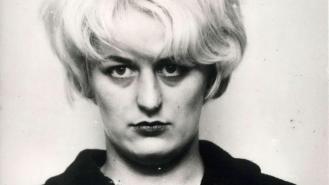
After her husband died in 1604, the allegations intensified. The disappearance of peasant girls had attracted little attention, but when daughters of the lesser nobility also began vanishing from her estates, the accusations became harder to ignore.
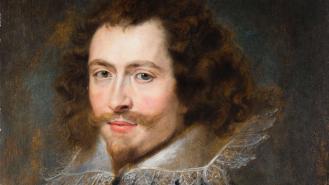
When Lutheran minister István Magyari publicly denounced Elizabeth, King Matthias II assigned György Thurzó to investigate. He was a powerful Hungarian nobleman who served as Palatine of Hungary from 1609.
The allegations against the Blood Countess
During the investigation, Thurzó and his task force collected more than 300 witness testimonies accusing Elizabeth of extreme brutality and murder.
One came from 35-year-old Tamás Nyereghjárto, who said he saw a girl from the castle with flesh torn from her right hand and her tendon destroyed. His account was corroborated by two other witnesses, one of whom described the girl’s hand as ‘completely destroyed’. When asked who had caused her injuries, the girl reportedly replied: ‘The Lady Widow Nadasdy had done it.’
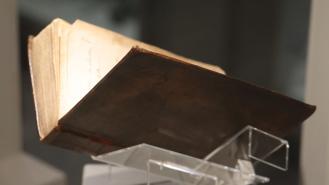
Other alleged crimes included ‘severe beatings with cudgels, needles inserted into lips, arms, shoulders, and fingernails, flesh cut out from the buttocks and from between the shoulders, and then roasted’.
Perhaps most damningly, several witnesses provided firsthand accounts of Báthory’s violence. Benedek Deseo, who oversaw operations at the castle, testified that Elizabeth ‘took a shoemaker's daughter…stripped her naked and began to cruelly torment her by taking a knife, and beginning with the fingers, shoved the knife into both arms up the arms, then flogging her over again’.
Despite hundreds of allegations against her, Elizabeth was never formally convicted of these crimes. There was no physical evidence linking her to the missing girls, but her reputation was already unsalvageable. She was confined to Čachtice Castle until her death in 1614.
Serial killer or political pawn?
Some scholars have since argued that Elizabeth wasn’t a cold-blooded killer, but the victim of a calculated smear campaign.
Her adversaries had plenty of motives for wanting her out of the way. She was an immensely wealthy landowner who controlled large areas of Hungary. King Matthias II, who had ordered the investigation, also owed her late husband a substantial debt.
Some academics have gone even further. Professor Annouchka Bayley argues that 'the countess was a religious subversive, a book printer and book smuggler and a radical feminist who used her vast wealth and castle home to educate vast numbers of young women and girls.'
More than 400 years after her death, we still don’t know the truth about Elizabeth Báthory, but her legend remains difficult to kill.
For more on the historical figures whose crimes – or alleged crimes – have fascinated the world for centuries, sign up to the Crime+Investigation newsletter. Every week, you'll receive the latest articles, episodes and more from C+I delivered straight to your inbox.